
Searching Livingston County Criminal Dockets
Begin a public Livingston County criminal register search at MiCOURT Case Search. The 53rd District Court points eligible public searches to that free state service. The 44th Circuit Court does the same. An exact case number gives the cleanest docket search. Party names work when the number is unknown. Still, confirm the court before assuming a result is the right Livingston County case. Confirm the case year too.
MiCOURT is a public case-history tool. It is not the official paper or certified record. When the register omits a filing you need, figure out which Livingston County court owns the case. Then ask its clerk for a copy. The county's access order asks for a full case number or party names. It also states that staff will not run open-ended file searches by telephone or fax.
- Open MiCOURT and select the Livingston County criminal case that matches the court, year, and participant information.
- Use the exact case number when it is available, then open the public register of action for the matching result.
- Read the court name first. A Livingston County 53rd District Court criminal record can be an early felony matter or a misdemeanor case.
- Review the dated entries for charges, hearings, motions, plea activity, disposition, and any later sentencing entry.
- For a copy or certification, contact the responsible Livingston County clerk with a defined request rather than relying only on the online display.
Note: A name match alone does not prove a Livingston County criminal register belongs to the person or case you are after.
Livingston Criminal Searches by Court
Criminal work in Livingston County divides by court level. The 53rd District Court handles misdemeanors plus the felony arraignment and preliminary path. The 44th Circuit Court takes a felony after bindover. It covers trial-level work, sentencing, and later assigned activity. This routing explains a common pattern. An early event appears in District Court while later events show up in Circuit Court.
A District felony record is not simply a copy of the Circuit record. The preliminary stage can end in bindover. Then the Circuit register becomes the relevant public destination where access is allowed. Under the current state rule, District or municipal felony case records become nonpublic after a bindover on or after July 2, 2024. Read the court transition as part of the case history itself.
| Livingston County court | Criminal docket role | Public search path |
|---|---|---|
| 53rd District Court | Misdemeanors and preliminary felony matters | MiCOURT register, then District clerk for a defined request |
| 44th Circuit Court | Felony trial work after bindover and related proceedings | MiCOURT register, then Circuit Clerk request form |
Inside a Livingston County Criminal Docket
A Livingston County criminal register of action is a chronological case-history record. It can identify the court, case number, parties, charges, hearing settings, filings, orders, and dispositions that are public. It does not promise that every attachment, exhibit, or protected filing opens online. Follow the dates in order. Match each status word to the event that caused it.
Case formatting varies by court and year in Livingston County. Do not guess at a local pattern. The public result's own identifier, such as Case Number / Case ID, is the strongest reference to carry into a clerk request. Calendar displays can add a CTN label, a time, hearing details, and a courtroom or magistrate location. Those fields describe a scheduled event only. They are not the final result.
| Case number | The court’s identifier for the Livingston County criminal matter and the best key for a copy request. |
|---|---|
| Charge entry | The filed accusation or cited count. Read it with later amendments, dismissal, plea, or judgment entries. |
| Setting | A dated court event such as arraignment, preliminary hearing, pretrial, motion, trial, or sentencing. |
| Order or disposition | The recorded ruling or case result. The entry date and specific count matter. |
| Access status | A notice that material is public, redacted, sealed, or otherwise limited under law or court order. |
The MiCOURT case-search reference lays out the field vocabulary that surrounds public case-search data. When a display is unclear, the Livingston County criminal docket remains the court record to verify it against.
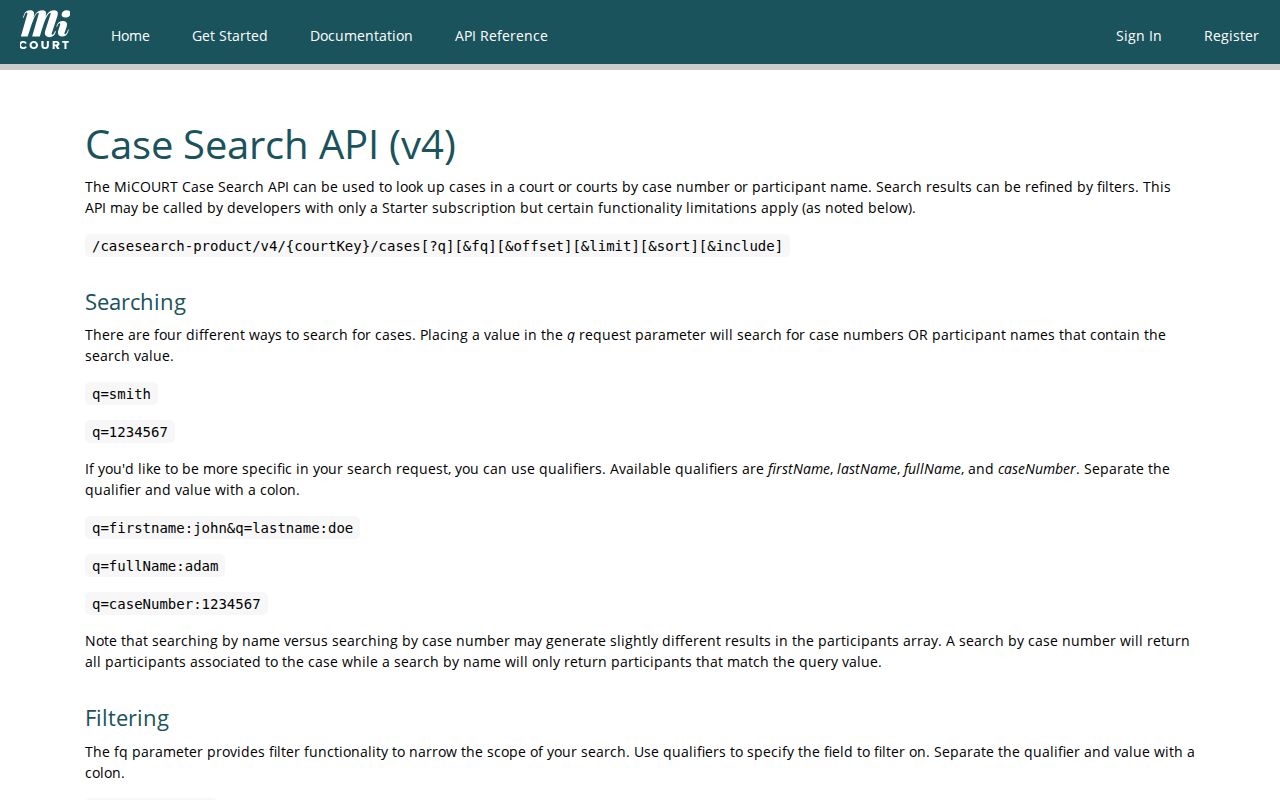
That field context helps you tell a case identifier apart from a name search. This matters most when several Livingston County criminal results carry similar party information.
Livingston Criminal Status Terms
Status words in a Livingston County criminal register need their dated context. "Pending" or "open" means activity continues in the displayed court record. "Disposed" means the court recorded a disposition. The entry itself must be read to learn the outcome. "Dismissed" records a dismissal event. Its reason and effect depend on the order and the charge. A plea or admission entry is not a sentencing entry.
Other status words describe procedure rather than result. A warrant or show-cause entry marks process or a hearing status, not guilt. Probation or treatment points to supervision or program activity, not the final outcome. A "sealed" or "nonpublic" label is an access status. It does not mean the case was dismissed. No conclusion should follow from the absence of a public result.
- Arraignment
- An early criminal setting where the case proceeds through the court process.
- Bindover
- The transfer point after a felony preliminary stage that can move the Livingston County case to Circuit Court.
- Disposition
- The case result recorded by the court. Read the specific entry and related order.
- Set aside or expunged
- A later court process affecting a conviction record, not a routine synonym for dismissal.
Note: Read any Livingston County docket label alongside its date, order, and court. It is not a stand-alone conclusion.
How a Criminal Case Moves
A misdemeanor can stay in 53rd District Court all the way through. That covers disposition too, in Livingston County. A felony usually starts with District Court arraignment and preliminary proceedings. After bindover, the 44th Circuit Court becomes the trial-level court for the felony. The public record can shift courts as the case moves forward. Each court preserves the part of the process it handled.
Livingston County criminal flow: Filing or charge → District Court arraignment → preliminary proceedings → bindover when ordered → Circuit Court plea or trial → disposition and sentencing.
Not every Livingston County criminal case walks through every step. A misdemeanor skips the felony bindover route entirely. A plea or a dismissal can cut the path short at almost any point. So read the docket with that flexibility in mind. A hearing date on a Livingston County criminal docket is only a setting. It is not proof the hearing happened or that it settled anything. Before you show up, confirm the Livingston County hearing schedule against the current notice.
Livingston Criminal Caseload Context
Official 2023 caseload figures give the Livingston County criminal register some scale. They name no one. The 44th Circuit Court logged 495 new criminal noncapital filings that year. It also recorded 569 dispositions and 175 cases ending pending. Downstairs on the ladder, the 53rd District Court reported 689 new non-traffic felony filings plus 564 new misdemeanor filings. Those are big numbers for one county. Just resist adding them together. The two totals track different stages and different jurisdiction, so they cannot be merged into one list of individual cases.
Want the underlying documents? The 44th Circuit report and the 53rd District report break the aggregate Livingston County workload down. They also explain why any Livingston County criminal search begins with naming the right court and the right stage.
Courts That Hold Criminal Dockets
Two Livingston County courts hold the central criminal records covered here. They are the 53rd District Court and the 44th Circuit Court. The District Court handles misdemeanors and felony preliminary matters. The Circuit Court, by contrast, is the county's general-jurisdiction trial court for felony cases after bindover. Overseeing the 44th Circuit and Family Court records is the Livingston County Clerk. The District Court keeps its own limited-jurisdiction case files.
Need a Circuit document? The Circuit Court Record Request Form lays out the county's copy and certification route. The Circuit Clerk sits in the Livingston Judicial Center, Suite 4, 204 S Highlander Way, Howell, Michigan 48843. That office answers the phone at (517) 546-9816. A District Court record goes elsewhere: route it to the 53rd District Court Clerk's Office, not to the Circuit Clerk.
The Livingston County Circuit Clerk page is the official hub. It shows the county's record-request steps along with its motion-docket resources. Going through the Livingston County clerk matters most when you need a certified copy. It also helps with a fuller public record, or something the public online register simply does not carry.
That clerk resource bridges the public register and the defined copy path, so a Livingston County criminal docket search does not stall just because the online display lacks a document you want. There is a real channel behind the screen. Note: A Circuit Clerk request reaches only the court that keeps the Livingston County record, so it does not automatically cover a District Court file.
Livingston Criminal Expungement Route
Expungement goes by another name in Michigan materials: setting aside a conviction. It starts in the court where the conviction happened. For a Livingston County conviction, that means the convicting court here. The state's official MC 227 application instructions walk an eligible applicant through the steps. File in that court. Obtain a certified copy of the conviction. Complete the application and the fingerprint process. Then send copies to the Michigan State Police, the Attorney General, and the prosecuting official as directed.
The fees stack up in a few places. The state form lists a $50 application fee payable to the Michigan State Police. A certified Livingston County record can carry its own local charges. The Circuit form lists $1.50 per page plus $10 per document for certification. Confirm eligibility, filing details, and current fees with the convicting court. The official state form covers those points too. Remember that expungement is a legal process. An older public display is not automatically removed just because a request was made.
Sealed Dockets and Public Access
Michigan presumes court records are public. Yet Livingston County criminal information can still be walled off by court rule, statute, redaction, or a direct court order. MiCOURT excludes or limits several protected categories. Those include juvenile matters, personal protection orders and their violations, mental-illness proceedings, ERPO matters, and other protected records. Some courts also fall under a seven-year criminal sentence filter on the portal. That filter points users to contact the court about older matters when it applies.
A blank Livingston County result proves nothing. The record could be hidden by a seal, a redaction, an excluded category, a transfer, or a portal limit. Any of those can explain the result rather than the absence of a case. Ask the responsible court for an access determination. Staff can explain the process. Protected material may still need a court order, authorization, or some other legal basis before you get in.
Michigan access rules. MCR 8.119 governs access to court records and sealing. MCR 1.109 addresses protection of personal identifying information. Livingston County’s 2025 access order provides the local inspection and copy process.
Do not send Livingston County court records requests through the county FOIA portal. It will not work there. The local order explains why: the judiciary sits outside Michigan FOIA's definition of a public body for court files. The correct route is the clerk. The court-record request process at whichever court holds the criminal docket handles it.
Livingston Criminal Specialty Courts
Livingston County runs several problem-solving dockets rather than one generic criminal docket. The four programs are Adult Drug Court, IT Mental Health Court, Swift & Sure Sanctions, and Veterans Treatment Court. The county lists all of them on its Specialty Courts page. None of them operates its own public lookup tool, though. Any case history that becomes public shows up in the underlying Livingston County criminal register, under the same rules that govern all court records.
Questions about a specific program belong with the official program contact or with Court Administration, not with the clerk's docket desk. Keep one limit in mind. A public register can list a hearing or case event while still shielding treatment details, medical facts, and other protected program material. For a Livingston County transcript, recording, or exhibit that never enters the public display, ask Court Administration or the clerk through the proper request channel.