
Livingston County Court Calendars Explained
Livingston County sorts its court calendars by court and by judicial officer. Start at the county's Hearing Schedules hub. That one page covers settings for Circuit, District, Family Court and Friend of Court. Probate sits there too. From there you can pull Circuit schedules for McGivney, Longsworth, Geddes, and Probate/Cavanaugh. District schedules cover Bain, Murphy, and Magistrate Sherwood. Family Court and Friend of Court post their own schedules for referees and staff. Many of the links hand off to a MiCOURT public court-display page. Hearings appear there.
Which court holds your case? It matters more than you might expect. The 44th Circuit Court handles felony trials, larger civil cases, Family Court, and juvenile matters. The 53rd District Court takes misdemeanors and felony preliminary matters. It also handles smaller civil cases, traffic, and civil infractions. The 47th Probate Court deals with estates, trusts, guardianships, conservatorships, and certain mental-health proceedings. So a Livingston County court calendar is really a family of separate calendars. It is not one master docket list.
Livingston County Court Calendar Links
Pick the right court or judicial officer first. Only then trust a date on a Livingston County docket. The public display can shift without warning. A mailed notice still counts for more than what a schedule page shows. A division's mailing address does not tell you which hearing room will be used, either. The county sends visitors to its schedule hub. MiCOURT Case Search can pull up an eligible public register of actions. Search it by case number or by participant information.
The assigned MiCOURT calendar source opens on a public calendar landing page. Pick a schedule link there and the JavaScript-driven behavior kicks in. That is what a visitor to the Livingston County court calendar should expect.
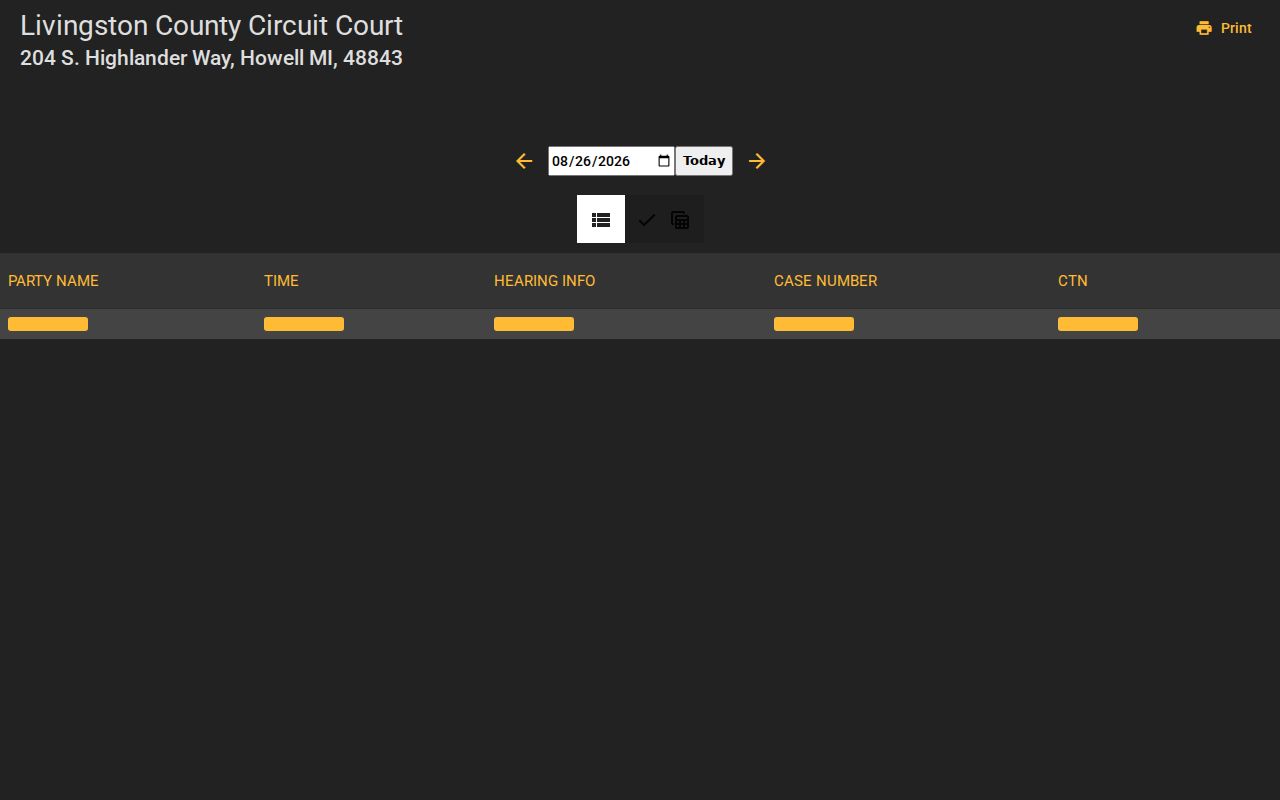
That calendar view works well for the current public schedule. Still, it should not replace the notice. Nor should it replace direct confirmation from the Livingston County court handling the matter.
Does a local case resist the online docket? Then call the responsible clerk. The clerk sits at the Livingston Judicial Center, 204 S Highlander Way in Howell. The Circuit Clerk sits in Suite 4 at (517) 546-9816. The 53rd District Court is in Suite 1 at (517) 548-1000. The 47th Probate Court is in Suite 2 at (517) 546-3750. A quick call to the right suite can settle a hearing time the public display leaves unclear.
Finding Your Court Date
A case number is the clearest route to a Livingston County court date. Without one, search by party name carefully. Confirm the court, case type, year, and case number before treating a result as the right case. The public calendar and the register of action do different jobs. The calendar shows upcoming settings. The register gives a chronological case history. One caution: a payment result is not proof of a legal disposition.
- Open the county Hearing Schedules hub and select the court, judge, referee, magistrate, or Probate calendar that fits the case.
- Use the public MiCOURT schedule or case search with the case number when available. A name result needs confirmation because similar names and spelling variations can produce more than one match.
- Read the current setting line for the date, time, hearing information, case number, and displayed location. Compare it with the court notice or information from the party’s attorney when one is involved.
- If the online calendar is incomplete, call the court that owns the case or use the clerk’s counter and public index at the Judicial Center. Court staff do not conduct open-ended file searches by phone or fax, so identify the case first.
Note: A public calendar can change after you check it. Confirm any important Livingston County court date before travel or a virtual appearance.
Livingston County Court Setting Labels
The public display uses hearing language that explains why an event is set. That language decides nothing by itself. An arraignment is an initial criminal appearance. A motion setting is time reserved to hear a request, not a ruling. A review checks progress or status. An informal hearing is a distinct hearing label. An evidentiary hearing is scheduled to receive evidence. For what actually happened, read the related register entry and order.
- Register of action
- The court’s chronological public case-history record, often called an ROA in Livingston County materials.
- CTN
- A label observed on the public calendar. The court should confirm its meaning for a particular record.
- MAG
- A displayed location label for a magistrate setting.
- Show-cause hearing
- A calendar setting label. Its appearance does not establish the result of the hearing.
How to Read a Court Setting
Treat a Livingston County court setting as a scheduling line. The date and time matter. They tell you when the calendar lists the event. The hearing information tells you the event type. The case number ties the entry to the public register. Location labels identify the court, courtroom, or magistrate designation shown by MiCOURT. A calendar may also show attorney, prosecutor, or officer indicators. That does not make every filing public.
| Date | The scheduled calendar date. Check the current notice if the date is important. |
|---|---|
| Time | The hearing time shown in the public display, which may differ from arrival instructions. |
| Hearing Info | A label such as arraignment, show-cause, review, motion, informal, or evidentiary hearing. |
| Case Number | The public case reference used to compare the setting with the register of action. |
| CTN or Location | A displayed interface or location label, including values such as Ct 1, Ct 3, Ct 5, or MAG; do not guess its room geography. |
A hearing title is not a judgment, a dismissal, or a finding of liability. It only records a setting. For the fuller public record behind a date, a Livingston County case lookup can lead to the accessible register of action for the matching case.
Livingston County Virtual Court Dates
Some Livingston County settings happen remotely. The county's virtual-hearing instructions tell participants to use Zoom when their notice or court directs it, log in 15 minutes early, use a full first and last name, stay muted unless called, remain visible and appropriately dressed, and remain until dismissed. Court-specific instructions control over general preparation steps.
Meeting credentials are not a permanent calendar field. A participant who gets disconnected should rejoin and promptly notify the probation officer or the appropriate court contact, as the county instructs. If the online schedule shows no clear location or access detail, contact the court that owns the case rather than assuming the date is remote or in person.
Continuances, Resets, and Cancellations
A Livingston County court setting can be adjourned, canceled, moved, or closed to the public. The calendar may keep showing a case number. The filings behind it may not be available to you. And a hearing label never settles whether a motion was granted. The court posts no guaranteed update interval. So the current schedule plus the official notice beat anything older, whether that is an earlier calendar entry or a saved copy of the page.
When a setting looks like it moved, go back to the Hearing Schedules hub first. A judge-specific page can come up blank, throw a 403 response, or return partial results. When that happens, call the court or use the clerk and index in person. The county itself tells visitors to verify court matters through its official phone numbers and portals. That advice matters most when a change affects whether you must appear.
Livingston County Court Calendar Access
MiCOURT calendar pages lean on JavaScript. Some judge-specific links respond with a 403 error or load only part of the schedule. Treat that as a technical hiccup, nothing more. It does not mean a hearing was canceled. And it does not mean the record is gone. Go back to the county schedule hub instead. Confirm you have the right court, and use that court's contact line or public index for a current answer on any Livingston County court dates.
Public calendars also draw boundaries. Juvenile, family, Friend of Court, protection-order, adoption, mental-health, sealed, and redacted records may be left out. They may be trimmed too. So a missing entry on a Livingston County docket search can point to a restriction, a transfer, an older case caught by a filter, or a case not yet indexed. It never proves that no court matter exists. Do not use automated collection or rate-limit bypasses on MiCOURT; the portal prohibits bulk downloading and scraping.
If You Miss a Court Setting
Missed a Livingston County court setting? Act fast. Pull up the current register or schedule first. Then reach your attorney if one represents you. And contact the court that issued the notice. Court staff will explain local routing, though they cannot offer legal strategy. The right next step hinges on the case type, the notice itself, and any order already entered.
Missed a Setting? A missed court date can have serious case-specific consequences, so verify the status through the official court contact and follow any order or notice.
Use an official county phone number or portal to check court information. Livingston County warns about fraudulent calls or messages that falsely claim an arrest warrant or demand money.
Do not pay a caller based only on a threat. The county ticket instructions also state that ordinary credit-card phone payments are not accepted.
Livingston County Court Calendar Privacy
A public hearing schedule is not the whole public file. Michigan court rules can hold back specific docket entries or documents. So can redaction requirements and court orders. Under the local access order, anyone needing an access determination must identify the case. That person then uses the responsible clerk's record process. The same order keeps case records under clerk control unless a court order says otherwise.
Keep your approach narrow. Use the Livingston County court calendar to find a public setting. Use the register of action to see how the case unfolded. Turn to the clerk's request path when you need an accessible copy. That distinction matters: an open proceeding is one thing, while a document may still be redacted, sealed, or nonpublic.